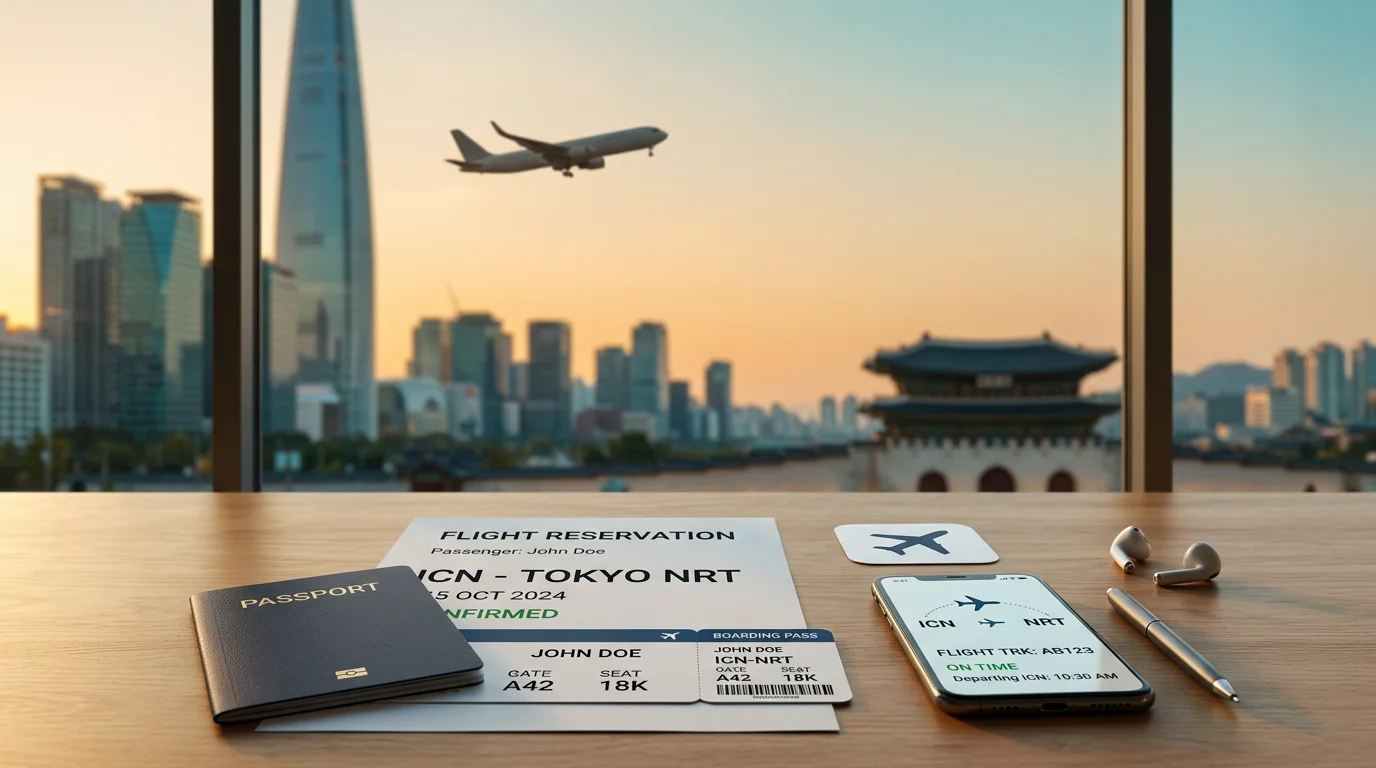
Dummy Ticket for South Korea Visa from India: Complete 2026 Guide
A dummy ticket for South Korea visa from India is a verifiable flight reservation with a live PNR, submitted alongside your C-3-9 tourist visa application at KVAC (Korea Visa Application Centre) or the Korean Embassy. It proves your travel intent without locking up ?40,000+ on a non-refundable ticket before your visa is even approved, and it is delivered in about 15 minutes for ?475.
Search "Seoul trip" on Instagram right now and you will find half of India's twenty-somethings standing in front of a palace gate or a glass tower in Gangnam. South Korea has quietly become one of the fastest-growing outbound destinations for Indian travelers — driven by K-dramas, K-pop tourism, direct flight additions, and a government that has openly named India as a priority growth market for 2025–2026. Naturally, visa applications have spiked, and with them, a wave of confusion around documentation that nobody is writing about clearly for an Indian audience.
This guide fixes that. No vague "requirements may vary" filler — exact visa category, exact KVAC cities, the K-ETA confusion that trips up almost everyone, and exactly where a flight itinerary fits into your file.
Do Indian Travelers Actually Need a Visa for South Korea?
Yes — and this is where most blog posts on this topic go wrong. South Korea does not offer visa-on-arrival, an e-visa, or K-ETA eligibility to Indian passport holders. Every Indian traveler, regardless of purpose, must apply for a sticker visa before departure.
The K-ETA Confusion, Cleared Up Properly
K-ETA (Korea Electronic Travel Authorization) is a pre-travel screening system, similar in concept to the US ESTA, that lets citizens of around 22–112 visa-exempt countries (USA, UK, most of the EU, Japan, Singapore, Australia, and others) enter South Korea without a full visa. South Korea has extended this K-ETA exemption for those nationalities through December 31, 2026.
India is not on that visa-exempt list. If you are an Indian passport holder, K-ETA does not apply to you in any form — not as a replacement for a visa, not as an add-on, and not as something you need to separately apply for. You need the actual sticker visa, full stop. A lot of recent K-ETA "extension" news has confused Indian travelers into thinking the rules changed for them too. They didn't.
The e-Arrival Card — A Separate, Newer Requirement
Since February 24, 2025, all foreign visitors to South Korea, including Indian visa holders, must complete an electronic arrival declaration at the official e-Arrival Card portal (e-arrivalcard.go.kr) up to three days before landing. This is not your visa, and it does not replace any visa documentation — it is an additional digital form that speeds up immigration at Incheon. Indian travelers need to complete it regardless of having an approved visa.
What Is the C-3-9 Short-Term Tourist Visa?
The standard visa category for Indian leisure travelers is the C-3-9 Short-Term Tourist Visa, permitting a single stay of up to 30 days within a 90-day validity window from issue.
| Visa Type | Stay Permitted | Approx. Embassy Fee (INR) | Processing Time |
|---|---|---|---|
| C-3-9 Single Entry (Tourist) | 30 days | ?3,400–3,500 | 5–10 working days |
| C-3-9 Multiple Entry | 30 days per visit | ?7,650 | 5–15 working days |
| D-2/D-4 (Student) | Course duration | Varies | 10–15 working days |
Always confirm the latest fee on the official Hi Korea visa portal before applying — embassy fees and processing windows do get revised.
Applications go through the Korea Visa Application Centre (KVAC), operated by VFS Global, with centers in Delhi, Mumbai, Chennai, Kolkata, and Bengaluru, or directly at the Korean Embassy/Consulate. Express processing has historically been available at Chennai and Bengaluru but suspended at Delhi and Kolkata centers at various points — check current availability for your city before assuming a fast-track option exists.
Where a Flight Itinerary Fits Into Your Korea Visa Application
KVAC's document checklist for the C-3 tourist visa typically asks for a flight itinerary or return/onward ticket showing your entry and exit dates from South Korea, matched with your stated trip duration. This is exactly the kind of document Schengen, UK, US, and Canadian embassies also ask for — and the same underlying logic applies: the consulate wants to see a travel plan, not proof that you have already spent ?35,000–?50,000 on a non-refundable airline ticket weeks before your visa decision.
Buying a confirmed, non-refundable ticket before approval is a real financial risk — if your visa is delayed, rejected, or your dates shift, that money is often gone. A verifiable dummy ticket — a genuine reservation created through an official Global Distribution System (GDS) like Amadeus or Galileo, with a real 6-character PNR — satisfies the same checklist item without that risk.
What Is a Dummy Ticket, Specifically?
It is a temporary airline reservation made in your name, showing your real route, dates, and a live PNR that anyone — including a KVAC document checker — can verify on the airline's "Manage Booking" page. It is not a forged PDF, and it is not the same as the free generator PDFs floating around the internet that show invented or already-expired PNRs. Those fail instantly the moment someone tries to check them, and a failed check on a single document is enough to put your whole application under extra scrutiny.
A dummy ticket is legal — it's a standard, widely used practice across visa categories worldwide, precisely because embassies themselves advise against committing financially before approval.
Complete Document Checklist: South Korea C-3 Tourist Visa from India
Carry originals plus self-attested photocopies of everything below to your KVAC appointment:
- Valid passport — minimum 6 months validity beyond your intended return date, with at least 2 blank pages
- Visa application form — completed and signed
- Recent photograph — 3.5cm x 4.5cm, white background (note: this is a different size than the standard 3.5cm x 3.5cm used for many other visa photos, so don't reuse old photos)
- Verifiable flight itinerary — round-trip, live PNR, matching your stated visa dates (this is where your dummy ticket goes)
- Hotel booking / accommodation proof — for your full stay duration
- Financial proof — bank statements (3–6 months), ITR for the last 2 years, salary slips
- Employment proof — appointment letter or NOC for salaried applicants; business registration for self-employed
- Day-wise tour itinerary — Seoul, Busan, Jeju, wherever your trip covers
- Cover letter — explaining purpose of visit, employment, and ties to India
How to Get a Dummy Ticket for South Korea Visa — Step by Step
- Go to CheapDummyFlight.com and select the Dummy Flight (or Flight + Hotel combo, since Korea visa checklists ask for both) option
- Enter your route and dates — for example, Delhi/Mumbai to Seoul (Incheon), with travel dates inside your planned 30-day stay window
- Choose a real operating airline — for India–Korea routes that typically means one-stop connections via Korean Air, Asiana, Singapore Airlines, or Thai Airways
- Enter passenger details exactly as they appear on your passport — even a missing middle initial can trigger a name-mismatch flag at document review
- Pay — ?475 for flight only, or around ?660 for the flight + hotel combo, via Razorpay (UPI/cards) or PayPal
- Receive your PDF — delivered to email and WhatsApp within 15 minutes, live PNR included
- Verify before your KVAC appointment — open the airline's official site, go to Manage Booking, enter the PNR and your surname, and screenshot the result for your records
Order your dummy ticket 2–4 days before your KVAC submission, not weeks ahead. Reservations are typically live in the GDS for 3–14 days before auto-expiring, which is exactly the window you want for a fresh, checkable document at the time of submission.
Five Mistakes Indian Applicants Make With Korea Visa Flight Proof
Mistake 1: Assuming K-ETA replaces the visa. It doesn't, for Indian passports. Don't apply for K-ETA thinking it gets you out of the sticker visa process — it has zero relevance to your application.
Mistake 2: Skipping the e-Arrival Card. This is separate from your visa and easy to forget since it's a newer (2025) requirement. Complete it within 3 days of arrival, not before.
Mistake 3: Booking flights via low-cost carriers for the dummy reservation. Pure LCC routes often can't hold an unpaid PNR the same way full-service carriers can. Stick to airlines that actually fly the India–Korea sector with proper GDS support.
Mistake 4: Submitting a flight itinerary that doesn't match your day-wise tour plan. If your itinerary says 12 days in Seoul/Busan/Jeju but your flight shows a 30-day gap between arrival and departure, that inconsistency is the first thing a reviewer notices.
Mistake 5: Buying a real, non-refundable ticket "just to be safe." This is the single most expensive mistake travelers make across every visa category, not just Korea. The whole point of the checklist item is that embassies don't want you to do this.
Do You Need a Dummy Hotel Booking Too?
Often, yes. KVAC's checklist commonly asks for accommodation proof alongside the flight itinerary, especially for first-time applicants without a host or invitation letter in Korea. A dummy hotel booking — a temporary, cancellable reservation under your name for your stay dates — covers this without prepaying a real hotel before approval. Ordering the Flight + Hotel combo in one go keeps both documents consistent on dates, which matters more than people realize during document review.
Frequently Asked Questions
Is a dummy ticket legal for a South Korea visa application?
Yes. A dummy ticket is a genuine, GDS-backed flight reservation, not a forged document. It exists in the airline's real booking system and can be verified by anyone with the PNR and surname. Submitting a flight reservation instead of a fully paid ticket is standard, widely accepted practice for visa applications worldwide, including for South Korea.
Do Indian passport holders need K-ETA for South Korea?
No. K-ETA only applies to citizens of countries that are visa-exempt for South Korea — a list that does not include India. Indian travelers must apply for the regular C-3-9 sticker visa through KVAC or the Korean Embassy; K-ETA has no bearing on their application.
How much does a South Korea tourist visa cost for Indians in 2026?
The C-3-9 single-entry tourist visa fee is approximately ?3,400–3,500, while a multiple-entry visa runs around ?7,650, based on the most recent embassy fee revision. These are government fees and don't include KVAC service charges, which are additional.
Can I use one dummy ticket for both the South Korea visa and the e-Arrival Card?
Not directly — the e-Arrival Card is a separate digital form completed after your visa is approved and closer to your actual travel date, using your real (or eventual) flight details. Your dummy ticket is used at the visa application stage only.
How long is a dummy ticket valid before it needs to be renewed?
Typically 3 to 14 days, depending on the airline and route. Order it 2–4 days before your KVAC appointment so it's verifiably live on submission day rather than risking expiry mid-process.
Which airlines should I choose for a South Korea dummy ticket from India?
Choose carriers that genuinely operate India–Korea routes: Korean Air, Asiana, Singapore Airlines (via Singapore), or Thai Airways (via Bangkok) are all realistic, GDS-friendly choices that match how Indian travelers actually fly to Seoul or Busan.
Will KVAC verify the PNR on my dummy ticket?
KVAC document reviewers and consular officers can and do check PNRs against the airline's Manage Booking system when something looks off. A GDS-backed verifiable reservation passes this check; a free PDF generator with an invented or expired PNR does not.
Is a hotel booking also required for the South Korea visa, or just a flight?
Most C-3 tourist applications ask for both a flight itinerary and accommodation proof for the full trip duration. A dummy hotel booking, ideally with dates matching your flight itinerary exactly, covers the accommodation requirement.
Conclusion
South Korea's visa process for Indians is more specific than most "general visa guide" articles let on — there's a real visa category (C-3-9), a real set of KVAC cities, a genuine K-ETA myth that needs busting, and a fairly new e-Arrival Card step that catches first-time applicants off guard. The flight itinerary requirement sits right in the middle of all of it, and it's the one part you can solve in 15 minutes without risking a single rupee on a ticket you might never use.
Get your verifiable South Korea flight reservation — or the flight + hotel combo — from CheapDummyFlight.com, starting at ?475, with a live PNR ready to check before you ever walk into KVAC.
Leave a Comment
Your email address will not be published. Required fields are marked *