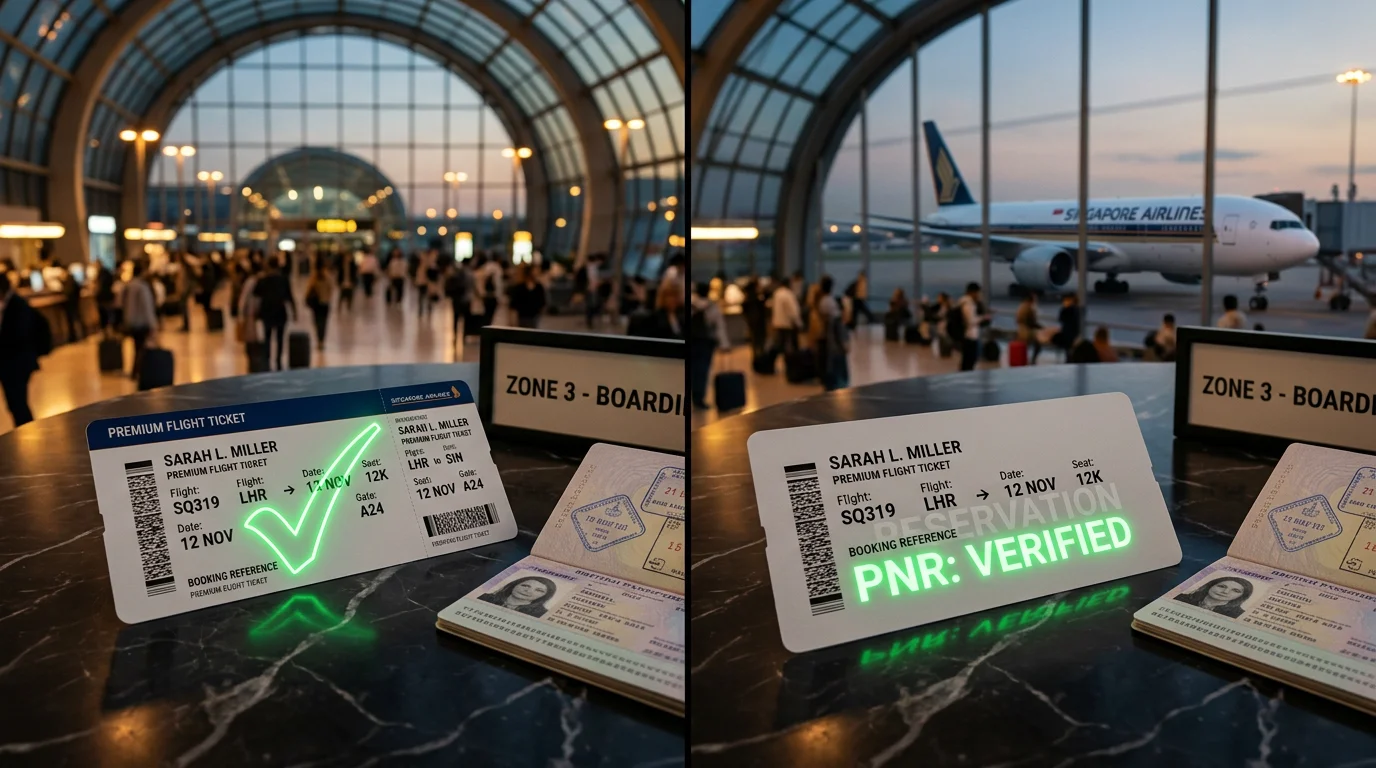
Is a Dummy Ticket a Real Ticket? The Clear, Complete Answer for 2026
Before you submit your visa application — or before you even buy a dummy ticket — this question deserves a precise, honest answer. Not a vague "yes and no" hedge. Not a paragraph of marketing fluff. Just the actual technical and practical truth about what a dummy ticket is and whether it qualifies as "real."
Here it is, stated plainly: a dummy ticket is a real reservation, but it is not a confirmed, paid, boarding-ready ticket. Those two things — a reservation and a confirmed ticket — are different stages of the same airline booking process. Understanding exactly where a dummy ticket sits between those two stages is what this entire article is about.
By the end of this guide, you will understand precisely what makes a dummy ticket real, precisely what it cannot do, and exactly why that distinction matters for your visa application.
Featured Snippet Answer: Is a Dummy Ticket a Real Ticket?
A dummy ticket is a real flight reservation — made through official airline systems — but it is not a confirmed, paid airline ticket. It has a genuine PNR (Passenger Name Record) that verifies on the airline's official website, contains real flight details, and is recognised by embassies worldwide as proof of travel intent. It cannot be used for check-in or boarding because the airfare has not been paid. Think of it as the first half of a real ticket — the reservation stage — without the second half, which is full payment and ticket issuance.
How an Airline Ticket Actually Works: Two Stages Most People Don't Know About
To understand what a dummy ticket is, you first need to understand something about how airline bookings work that most travellers never think about — because they usually go through both stages in one click.
When you book a flight on any major airline or travel platform, two things happen in rapid sequence:
Stage 1 — Reservation: A seat is selected and a PNR (Passenger Name Record) is created in the airline's reservation system. This entry records your name, the flight, the date, and the route. At this point, the seat is "held" for you.
Stage 2 — Ticketing: Full payment is made. The airline issues an e-ticket number (an 13-digit code beginning with the airline's numeric code). The seat is confirmed. You can now check in and board.
Most travellers experience both stages within seconds of each other — you fill in your details, pay, and receive your booking confirmation. But these are technically and legally two separate events. Airlines actually impose what is called a Ticket Time Limit (TTL) — a window between Stage 1 and Stage 2 during which a reservation exists but has not yet been ticketed. This window can be anywhere from a few hours to several weeks, depending on the airline's configuration.
A dummy ticket is Stage 1 — the reservation — without Stage 2.
That is the entire technical explanation. A dummy ticket is a PNR that has been created through the Global Distribution System (Amadeus, Galileo, or Sabre) by a licensed travel agent, with the reservation held during the TTL period. The seat is reserved. The passenger details are logged. The PNR is live and verifiable. Full payment is simply never made, so the seat eventually returns to the airline's inventory when the TTL expires.
What Makes a Dummy Ticket "Real"
When people ask whether a dummy ticket is real, they usually mean one of three things:
- Does a real flight reservation exist under my name in the airline's system?
- Can it be verified by the embassy when they check?
- Will it hold up if the airline or immigration officer looks it up?
The answer to all three is yes — when the dummy ticket comes from a legitimate GDS provider.
? It Creates a Real PNR in the Airline's System
Every legitimate dummy ticket generates an actual PNR entry in the airline's reservation database. This is not a simulated or fabricated reference number — it is a live, active record that the airline's own systems recognise. You can go to Emirates, Lufthansa, Qatar Airways, Air India, or any other supported carrier's official website, click "Manage Booking," enter your last name and the PNR, and your flight details will appear immediately.
That is what "real" means in the context of airline reservations — the record exists in the actual system. A dummy ticket from a GDS provider passes that test completely.
? It Contains Genuine, Verifiable Flight Data
A legitimate dummy ticket reflects a real operating flight — a real flight number, on a real airline, between real airports, on a real calendar date. The itinerary is not invented. It is drawn from the airline's actual schedule in the GDS. Route, timing, aircraft type, and flight number all correspond to a genuine service that operates on that date.
? It Is Issued by a Licensed Travel Agent
Reputable dummy ticket providers are licensed travel agencies or operate through IATA-accredited GDS partners. The reservation is created the same way any travel agent would create a preliminary booking for a client — through the official industry system. The only difference is that the final payment stage is never triggered.
? It Is Accepted by Embassies as a Valid Document
The Schengen visa guidelines, UK Visas and Immigration documentation requirements, IRCC Canada checklists, and UAE visa documentation standards all use the word reservation or itinerary — not confirmed ticket. They are designed to accept exactly this type of document: a real GDS reservation with a verifiable booking reference. A well-prepared dummy ticket is not a workaround for these requirements — it is precisely the document type that the requirements describe.
What a Dummy Ticket Cannot Do: The Limits of "Real"
Being honest about what a dummy ticket cannot do is just as important as explaining what makes it real. Here are its genuine limitations:
? You Cannot Board a Flight With It
A dummy ticket is a reservation, not a confirmed ticket. Airlines require a fully issued e-ticket — Stage 2 of the booking process — before allowing a passenger to check in. An airline agent who scans a dummy ticket's PNR will see an unpaid reservation, which does not grant boarding access. A dummy ticket is a documentation tool, not a travel document.
? It Has a Limited Validity Window
A dummy ticket remains active for its TTL period — typically 2 to 3 weeks from the date of reservation, depending on the airline's policy. After that window, the reservation auto-expires and the PNR shows as cancelled. This is why timing matters: book your dummy ticket 1–2 days before your visa submission, not weeks in advance.
? It Is Not an E-Ticket
A confirmed airline ticket has a 13-digit e-ticket number in addition to its PNR. A dummy ticket has only a PNR — because the ticketing stage has not been completed. For embassy purposes, the PNR is sufficient (and is what they check). For airline check-in purposes, the e-ticket number is what matters — and that only exists after payment.
? It Should Not Be Used at Airport Check-In
Some travellers confuse the use of a dummy ticket for visa documentation with using it to pass through an airline check-in counter. These are different scenarios. For visa applications, a dummy ticket is the standard and appropriate document. For actual travel, you need a fully paid, confirmed ticket with an e-ticket number.
The only exception: Using a dummy ticket as proof of onward travel at immigration — where an officer asks to see your exit plan, not a boarding-ready ticket. Here, a dummy ticket with an active PNR can satisfy the requirement, because the officer is verifying your travel intent, not preparing you for boarding.
Dummy Ticket vs. Real Ticket vs. Fake Ticket: The Full Spectrum
Many applicants confuse three distinct things. Here is the complete comparison that clarifies all of them:
Dummy Ticket (GDS Reservation)
- What it is: A real, live airline reservation created through Amadeus, Galileo, or Sabre
- PNR: ? Real, verifiable on the airline's website
- E-ticket number: ? Not issued (no payment made)
- Can board a flight: ? No
- Embassy accepted: ? Yes — this is the standard document type
- Legal: ? Completely legal
- Cost: $5–$25 service fee
Confirmed Real Ticket (Fully Paid)
- What it is: A completed booking with full airfare paid and e-ticket issued
- PNR: ? Real
- E-ticket number: ? Issued
- Can board a flight: ? Yes
- Embassy accepted: ? Yes — but usually not required before visa approval
- Legal: ? Completely legal
- Cost: Hundreds to thousands of dollars depending on route
Fake Ticket (Fabricated Document)
- What it is: A PDF edited or generated using a template, with no real airline record
- PNR: ? Fabricated — does not exist in any airline system
- E-ticket number: ? Not real
- Can board a flight: ? No
- Embassy accepted: ? No — will fail verification immediately
- Legal: ? Document fraud — serious legal consequences
- Cost: Often free or very cheap — which is the warning sign
The difference between a dummy ticket and a fake ticket is not cosmetic — it is structural. A dummy ticket exists in a real airline system. A fake ticket exists only in a PDF editor. When an embassy officer types the PNR into the airline's website, a dummy ticket displays a real reservation. A fake ticket displays nothing — or an error.
Why Embassies Treat a Dummy Ticket as a Real Booking
This surprises some applicants: if it is not a confirmed ticket, why does the embassy accept it?
The answer lies in what embassies are actually checking for.
A visa officer reviewing a flight document is not trying to confirm that you have spent money on a flight. They are trying to confirm three things:
- You have a specific, credible travel plan — with real dates, a real route, and a real airline
- Your stated itinerary is consistent with your other application documents (hotel, insurance, travel dates, purpose of visit)
- You intend to leave the country before your visa expires
A GDS-generated dummy ticket answers all three of these questions perfectly. It has a real route on a real airline with real dates. It can be matched against your hotel booking and travel insurance. And it demonstrates, through a verifiable reservation, that you have a concrete exit plan.
What the officer does not need to confirm is whether you have committed hundreds of dollars to a non-refundable flight before your visa is even approved. In fact, Schengen guidelines explicitly acknowledge this — the official position is that applicants should not be expected to purchase a confirmed ticket before visa approval, because rejection would cause financial harm. That is precisely why the guidelines use the word "reservation" rather than "confirmed ticket."
The Two Types of Dummy Tickets: Not All Are Equally "Real"
This is the nuance that most guides skip, and it is important. There are two fundamentally different types of documents sold as "dummy tickets":
Type 1: GDS-Verifiable Reservation (Genuinely Real)
Generated through Amadeus, Galileo, or Sabre by a licensed travel agency. Carries a live PNR that can be checked on the airline's official website in real time. This is a genuine airline reservation — it exists in the airline's actual booking system. This is what "real" means.
How to recognise it: The provider mentions Amadeus or Galileo. The PNR works when you test it on the airline's "Manage Booking" page. You receive a professional PDF that looks identical to any legitimate booking confirmation.
Type 2: Template PDF (Not Genuinely Real)
A professionally formatted document that looks like a booking confirmation but has no live record in any airline system. May carry a reference number that is either fabricated or recycled. Cannot be verified on the airline's website.
How to recognise it: The service is free or extremely cheap. The provider cannot confirm which GDS they use. When you test the PNR on the airline's website, nothing comes up — or the booking shows as cancelled or expired immediately.
For visa documentation, Type 1 is the only document that qualifies as genuinely real. Type 2 is, functionally, a fake ticket — regardless of how professional it looks on paper.
At CheapDummyFlight.com, every reservation is a Type 1 — generated through Amadeus or Galileo GDS by a licensed travel consultancy, with a live PNR that you can verify yourself before submitting anything to an embassy. Delivery takes 15 minutes. Supported airlines: 500+. Book your verifiable dummy ticket here from just $5.
How to Verify That Your Dummy Ticket Is Genuinely Real
This is the most practical thing you can do before submitting any dummy ticket to an embassy.
Follow these steps:
- Receive your PDF dummy ticket via email or WhatsApp from your provider.
- Locate the 6-character PNR (also called booking reference or locator code) on the document.
- Go to the airline's official website — not a third-party site.
- Find "Manage Booking," "My Trips," or "Check My Reservation" — these labels vary by airline but every major carrier has this function.
- Enter your last name and the PNR exactly as printed.
- If your full reservation details appear — passenger name, route, dates, flight number — the ticket is genuinely real. The reservation exists in the airline's system.
- If nothing appears, or you receive an error saying the booking cannot be found, contact your provider immediately. Do not submit this document to an embassy.
This one check takes under two minutes and tells you everything you need to know about whether your dummy ticket is real.
For more information on what the full dummy ticket booking process looks like step by step, read our Ultimate Flight Itinerary Guide.
What Happens When the Embassy Checks Your Dummy Ticket
This is a question closely related to "is it real?" — because what the embassy actually checks tells you a lot about what "real" means in practice.
Most embassies and VFS Global processing centres, when they check a dummy ticket, do one or more of the following:
- Enter the PNR on the airline's official website to confirm the reservation exists — this is the most common check
- Verify that the passenger name exactly matches the passport — spelling, order, and format must be identical
- Cross-reference travel dates against the hotel booking, insurance policy, and stated dates in the application form
- Assess the overall consistency of the document — format, airline branding, and routing should look professional and realistic
A genuinely real dummy ticket (Type 1 — GDS-backed) passes every one of these checks. The PNR verifies. The name matches. The dates can be aligned. The format is professional.
This is also why it is worth understanding that the embassy's check is not adversarial. They are not trying to catch you using a dummy ticket — they accept dummy tickets. They are checking that the document is genuine and consistent. A legitimate GDS reservation is designed to pass exactly that kind of scrutiny.
Our article on whether dummy tickets are safe to use covers the embassy verification process in more detail.
Frequently Asked Questions
Is a dummy ticket a real ticket?
A dummy ticket is a real reservation but not a real confirmed ticket. It is a genuine PNR entry in an airline's Global Distribution System — verifiable on the airline's own website — but it has not been progressed to the full ticket issuance stage through payment. Embassies accept it because it demonstrates a real, verifiable travel plan. It cannot be used for boarding because the airfare is unpaid.
Is a dummy ticket the same as a fake ticket?
No — they are fundamentally different. A dummy ticket is a real airline reservation with a verifiable PNR made through official airline systems (Amadeus, Galileo, Sabre). A fake ticket is a fabricated PDF with no real booking behind it. Dummy tickets are legal and embassy-accepted. Fake tickets are fraudulent and will fail verification immediately.
Can an embassy tell the difference between a dummy ticket and a confirmed ticket?
Yes. An embassy that checks the PNR can see the booking status in the airline's system — including whether it is a reservation (unpaid) or a confirmed ticket (fully paid with e-ticket number). However, this distinction does not disqualify a dummy ticket — embassies ask for a flight reservation, which is exactly what a dummy ticket is. The check they care about is whether the PNR is real and active — not whether the fare is paid.
What makes a dummy ticket "real" enough for a visa?
Three things: a live PNR that verifies on the airline's official website, accurate passenger details matching the passport, and travel dates consistent with the rest of the application. A GDS-generated dummy ticket from a reputable provider delivers all three. That is all "real" means in the context of visa documentation.
Is a dummy ticket as good as a real ticket for visa purposes?
For visa application purposes, yes — a dummy ticket is equivalent to a confirmed ticket as documentation. Both contain the same information (passenger name, airline, route, dates, booking reference), and both verify the same information for the embassy officer. Many embassies explicitly prefer reservations over confirmed tickets because they do not want applicants to take financial risk before visa approval.
What is the difference between a dummy ticket and a flight reservation?
They are the same thing. "Dummy ticket" is the traveller-facing term. "Flight reservation" is the technical and embassy-facing term. Both refer to a GDS-generated PNR hold — a real airline reservation that has not yet been progressed to full ticket issuance.
Can I convert a dummy ticket into a real ticket for actual travel?
No — not directly. A dummy ticket is a reservation that auto-expires. To fly on the same route, you would need to book a separate, fully paid ticket through the airline or a travel agent. The dummy ticket's job ends at the documentation stage; your actual travel booking is a separate transaction.
How do I know if my dummy ticket is genuinely real?
Test the PNR yourself on the airline's official website under "Manage Booking." If your full reservation details appear — name, route, dates, flight number — the ticket is a genuine live reservation. If nothing appears or you receive an error, the ticket is not genuinely real and should not be submitted to an embassy.
Conclusion
A dummy ticket is real — in the precise sense that matters. It is a genuine flight reservation, made through official airline systems, with a live PNR that verifies on the airline's own website. It contains real flight details on a real operating route with real travel dates. It is accepted by embassies worldwide because it is exactly the type of document they request: a flight reservation proving your intended travel plan.
What it is not is a confirmed, paid, boarding-ready airline ticket. That distinction is important — and honest — but it does not diminish the document's value for visa purposes one bit. Embassies do not require confirmed tickets; they require reservations. A dummy ticket is a reservation.
The confusion almost always comes from the word "dummy" — which sounds provisional, fake, or questionable to someone hearing it for the first time. Strip away the name, and what you have is a real GDS reservation used exactly as GDS reservations were designed to be used: as proof of intended travel before the full booking is finalised.
Whether you are applying for a Schengen visa, a UK Standard Visitor visa, a Canada TRV, or showing proof of onward travel at a Southeast Asian border — a properly issued dummy ticket from a legitimate GDS provider is a real, trustworthy, verifiable document that does exactly what it promises.
Ready to get yours? Book your verifiable dummy ticket at CheapDummyFlight.com — starting at $5, delivered in 15 minutes, with a live PNR you can verify yourself before submitting anything.
Need a complete picture of what documents your visa requires? Read our Ultimate Flight Itinerary Guide and browse our FAQ page for answers to every common visa documentation question.
Last updated: June 2026 | Content verified against current Schengen, UK, UAE, Canada, and US visa documentation standards and IATA GDS reservation practices.
Internal Linking Opportunities
| Anchor Text | Target URL |
|---|---|
| "Book your verifiable dummy ticket at CheapDummyFlight.com" | https://cheapdummyflight.com/#booking-section |
| "Ultimate Flight Itinerary Guide" | https://cheapdummyflight.com/guide.php |
| "FAQ page" | https://cheapdummyflight.com/faq.php |
| "whether dummy tickets are safe to use" | https://cheapdummyflight.com//blog/are-dummy-tickets-safe-to-use/ |
| "is it legal to book a dummy ticket" | https://cheapdummyflight.com//blog/is-it-legal-to-book-a-dummy-ticket/ |
| "is a dummy ticket legal?" | https://cheapdummyflight.com//blog/is-a-dummy-ticket-legal-the-honest-complete-answer-for-2026/ |
| "how much does a dummy ticket cost" | https://cheapdummyflight.com//blog/how-much-does-a-dummy-ticket-cost/ |
| "free visa cover letter generator" | https://cheapdummyflight.com/cover-letter-generator.php |
External Authority Reference Suggestions
- IATA GDS and Reservation Standards: https://www.iata.org/en/programs/ops-infra/distribution/
- Schengen Visa Handbook — EU Commission: https://home-affairs.ec.europa.eu/schengen_en
- UK Visas and Immigration — Standard Visitor Evidence: https://www.gov.uk/standard-visitor
- IRCC Canada — Visitor Visa Supporting Documents: https://www.canada.ca/en/immigration-refugees-citizenship/services/visit-canada.html
- VFS Global Schengen Document Checklist: https://www.vfsglobal.com
Leave a Comment
Your email address will not be published. Required fields are marked *