What Is a Dummy Ticket? The Complete Beginner's Guide for 2026
If you have just discovered the term "dummy ticket" while preparing a visa application, you are in the right place. The name sounds unofficial — even a little suspicious — but a dummy ticket is one of the most commonly used, legally accepted, and practically essential travel documents in the world today.
This guide explains everything from scratch: what a dummy ticket actually is, how it works technically, what it looks like, when you need one, when you do not, and how to get a genuine one in under 15 minutes. No jargon, no assumptions, no fluff.
The Simplest Definition: What Is a Dummy Ticket?
A dummy ticket is a temporary, verifiable flight reservation — made in your name, on a real airline, for a real route — that is used as a travel document for visa applications, immigration checks, and proof of onward travel, without requiring you to purchase the actual flight.
It is also called a flight reservation, flight itinerary, or temporary booking. All four terms refer to the same document.
Here is what makes it different from a paid airline ticket: you are not buying the flight. You are reserving a seat — temporarily — to show an embassy officer, border control agent, or airline staff that you have a concrete travel plan. Once your visa is approved, the reservation either expires automatically or you replace it with a real booking.
Think of it like placing a dinner reservation at a restaurant. The table is held in your name, and it is a real reservation in the system. But you have not paid for the meal yet — and if your plans change, you simply do not show up. The dummy ticket works the same way.
The Featured Answer: A Complete One-Paragraph Definition
A dummy ticket is a real, GDS-generated flight reservation with a live, verifiable PNR (Passenger Name Record) that appears in an airline's official booking system. It contains your passport name, flight number, route, and travel dates — identical to a confirmed booking confirmation — but the airfare has not been paid. It is used primarily for visa applications, where embassies require proof of a travel plan without expecting applicants to purchase expensive non-refundable tickets before their visa is approved. A legitimate dummy ticket can be verified by any embassy officer on the airline's official "Manage Booking" page in under two minutes.
Why the Word "Dummy" — And Why It Does Not Mean Fake
This is the question that trips up more first-time users than anything else. The word "dummy" does not mean fake, forged, or fraudulent. In travel industry terminology, it simply means placeholder — a reservation that stands in place of a confirmed ticket while you wait for visa approval.
The same concept exists across professional fields. In printing, a "dummy" is a draft copy that represents the final product. In engineering, a "dummy load" is a test component. In the travel industry, a dummy ticket is a test booking — a live, real reservation that holds your place without completing the purchase.
The confusion comes from associating "dummy" with "fake." But a fake ticket — an edited PDF, a fabricated booking reference, a screenshot with altered details — is something completely different. A fake ticket has no real booking behind it. A dummy ticket has a genuine reservation in the airline's actual database, verifiable in real time.
One passes embassy verification. The other does not. That is the whole difference.
How a Dummy Ticket Actually Works: The Technical Side, Simply Explained
To understand what a dummy ticket is, it helps to know how airline reservations work — and it is simpler than most people assume.
Stage 1 — Reservation (What a Dummy Ticket Is)
When any flight is booked — through a travel agent, an online portal, or an airline's own site — the first thing that happens is a reservation. A seat is selected on a specific flight, and a PNR (Passenger Name Record) is created in the airline's central database. The PNR is a unique six-character alphanumeric code that identifies your booking.
At this point, the booking exists in the system. It is real. But the fare has not been paid yet.
Stage 2 — Ticketing (What a Paid Ticket Adds)
After a reservation is created, the next step is ticketing: full payment is made, and the airline issues a 13-digit e-ticket number. Now you have a confirmed, paid, boarding-ready ticket.
Where a Dummy Ticket Sits
A dummy ticket is Stage 1 only. A licensed travel agency or consultancy creates a real PNR in the airline's system — through an official Global Distribution System (GDS) like Amadeus, Galileo, or Sabre — and delivers that booking confirmation to you as a PDF. The fare is never paid, so Stage 2 never happens. The seat returns to the airline's inventory when the hold period expires (typically 2–3 weeks).
This is not a workaround or a loophole. Airlines build these holds into their systems deliberately — they are called Ticket Time Limits (TTL) — and they are a standard part of how airline reservations have worked for decades.
What a Dummy Ticket Looks Like: The 7 Elements on Every Document
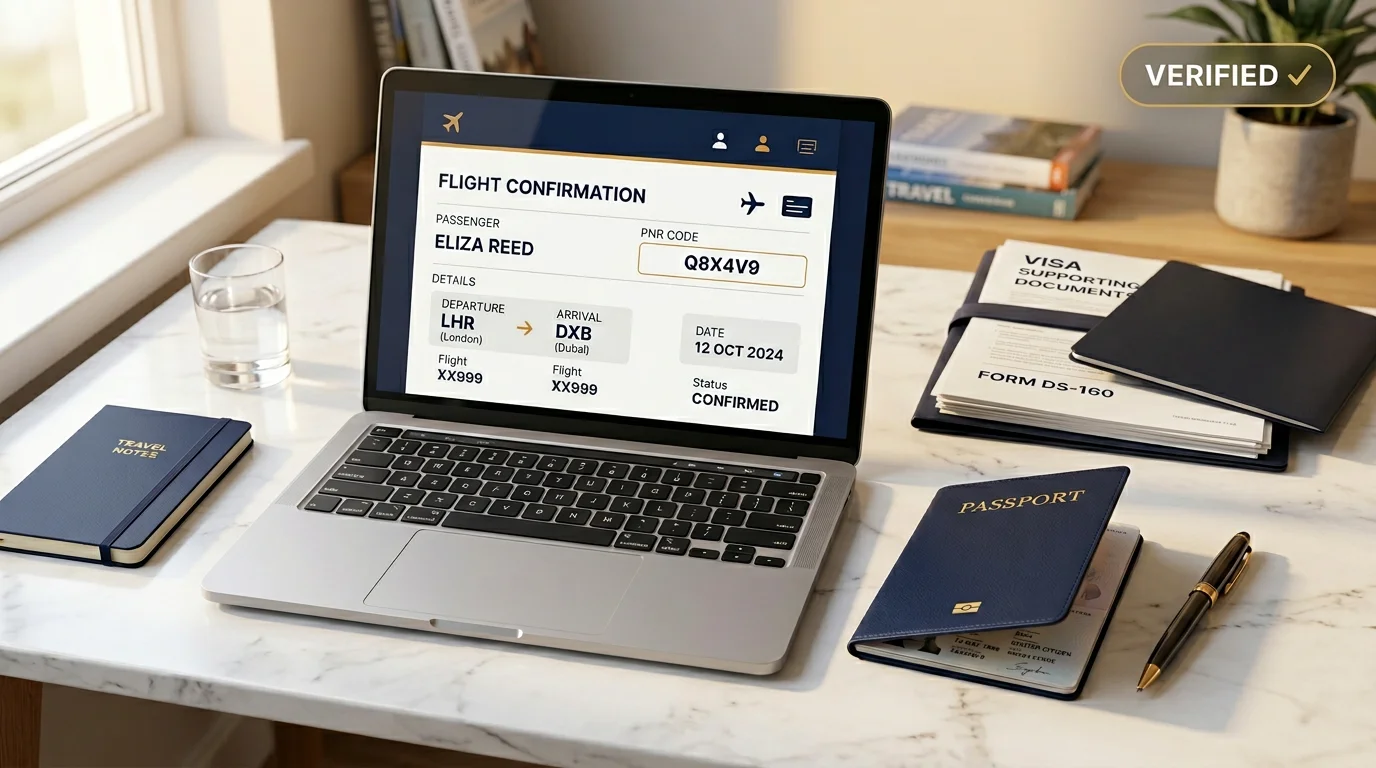
A legitimate dummy ticket is a professional PDF document. It looks identical to any booking confirmation you would receive from a travel agent or online booking portal. Here is what every element on the document means:
1. Passenger Name
Your full legal name, exactly as it appears in your passport — surname, given name, title. This must match perfectly. Any discrepancy will flag the document at the embassy.
2. PNR / Booking Reference
The six-character alphanumeric code (e.g., ABC123) that identifies your reservation in the airline's system. This is the most important element — it is what the embassy officer types into the airline website to verify your booking. Every legitimate dummy ticket has a real, active PNR.
3. Airline Name and Logo
The carrier on whose system the reservation is held. Reputable dummy ticket providers have access to 500+ airlines worldwide through their GDS connections.
4. Flight Number
The specific operating flight number for your route — for example, EK 204 (Emirates Flight 204 from Dubai to London). This corresponds to a real scheduled service that operates on your travel date.
5. Route Details
Departure and arrival airports (with IATA codes), departure time, arrival time, and any layovers or connecting flights if applicable.
6. Travel Date
The specific calendar date of your planned travel. This date must align precisely with your hotel booking, travel insurance, and visa application form dates.
7. Booking Class / Cabin
The class of service — economy, business, etc. — and the fare basis code. For visa documentation purposes, cabin class does not matter; what matters is that the flight and route are realistic.
The 5 Situations Where You Need a Dummy Ticket
Dummy tickets are not only for Schengen visa applications. Understanding the full range of use cases helps you know exactly when one is the right tool for your situation.
1. Visa Application — The Primary Use Case
Most visa-issuing countries — including all 26 Schengen nations, the UK, USA, Canada, Australia, UAE, Japan, and many others — require a flight reservation as part of the visa application document checklist. Their official guidelines deliberately ask for a reservation (not a confirmed purchased ticket) because they understand that applicants should not risk hundreds of dollars on a non-refundable ticket before knowing whether their visa will be approved.
A dummy ticket from a GDS provider is precisely the document they are asking for. It provides your travel route, dates, and a verifiable booking reference — everything the officer needs to assess your travel plan.
2. Proof of Onward Travel at Immigration
Several popular travel destinations — including Thailand, Indonesia (Bali), the Philippines, Malaysia, and Costa Rica — routinely ask travelers to show proof of onward travel at the immigration counter or during airline check-in. This is separate from a visa requirement; it is an immigration check.
If you are travelling on a one-way ticket, or if your plans are flexible and you have not booked a return flight, a dummy ticket with an active PNR serves as your exit plan. The immigration officer or airline agent sees a verifiable reservation showing when and where you plan to leave — and that satisfies their requirement.
3. Airline Check-In (When a Return Ticket Is Required)
Some airlines — particularly budget and regional carriers — require proof that you have an onward or return booking before they allow you to check in for a one-way international flight. This is especially common on routes to countries with strict immigration requirements.
A dummy ticket with an active PNR can satisfy this check at the airport, because the airline staff can verify the booking reference in the same system their own tickets use.
4. Passport Renewal
Many countries require a travel itinerary as part of the documentation for urgent passport renewal — to demonstrate that the applicant has an imminent travel plan that makes the renewal time-sensitive. A dummy ticket provides this documentation without the applicant needing to commit to a specific flight date before the passport is ready.
5. Company Leave Approval / HR Documentation
Corporate HR departments in India and other countries sometimes require employees to provide a travel itinerary when applying for extended leave — particularly international travel leave. A dummy ticket provides a professional, verifiable itinerary that meets this requirement without requiring the employee to purchase a non-refundable ticket weeks before their departure date is confirmed.
Dummy Ticket vs. Flight Reservation vs. Confirmed Ticket: What Is the Difference?
These three terms cause enormous confusion. Here is the complete breakdown:
Dummy Ticket
- Alternative names: Flight reservation, flight itinerary, temporary booking, onward ticket
- What it is: A real GDS reservation with a live PNR; airfare unpaid
- Verifiable on airline website: ? Yes
- Can be used for boarding: ? No
- Embassy-accepted: ? Yes — this is what they ask for
- Cost: ?475–?1,500 ($5–$20) service fee
- Validity: 2–3 weeks (airline-dependent hold period)
Confirmed Ticket
- What it is: A fully paid booking with an issued e-ticket number
- Verifiable on airline website: ? Yes
- Can be used for boarding: ? Yes
- Embassy-accepted: ? Yes — but usually not required before visa approval
- Cost: ?15,000–?1,50,000+ ($200–$2,000+) depending on route
- Risk: Financial loss if visa rejected and ticket is non-refundable
Fake Ticket
- What it is: An edited PDF, template-generated document, or screenshot with no real booking
- Verifiable on airline website: ? No — PNR does not exist or belongs to someone else
- Can be used for boarding: ? No
- Embassy-accepted: ? No — will fail verification and trigger rejection
- Legal status: ? Document fraud — potential visa ban and criminal consequences
- Cost: Free or ?50–?200 (suspiciously cheap is the warning sign)
The decision for any visa applicant is straightforward: a dummy ticket is the correct document type for visa applications, it costs a fraction of a confirmed ticket, and it carries no financial risk if your visa is rejected.
Who Uses Dummy Tickets? Real Traveler Profiles
Understanding who actually uses dummy tickets makes the concept more concrete.
The First-Time Visa Applicant
Riya from Delhi is applying for her first Schengen visa to visit France. She has never travelled to Europe before and does not want to buy a ?85,000 non-refundable flight ticket before knowing if her visa will be approved. She orders a dummy ticket for ?475, receives it on WhatsApp in 15 minutes, and submits it as her flight reservation with her visa application. When her visa is approved 12 days later, she books her actual flight.
The Digital Nomad
Marcus is a freelance designer who travels continuously. He arrives in Thailand on a one-way ticket from Vietnam, and the immigration officer at Suvarnabhumi airport asks to see his onward ticket. He pulls up his dummy ticket PDF on his phone — showing a departure to Singapore two weeks later — and the officer checks the PNR on the airline's system. The reservation verifies. He is waved through.
The Business Traveler with Uncertain Dates
Priya's company is sending her to the UAE for a project, but the project end date is unclear. She needs a leave application with travel dates for her HR department. She books a dummy ticket to Dubai with approximate dates, submits it for leave approval, and updates her actual booking once the project timeline is confirmed.
How to Get a Legitimate Dummy Ticket: The Step-by-Step Process
Ordering a legitimate dummy ticket from a reliable provider takes approximately three minutes. Here is the exact process:
- Go to the provider's website — for example, CheapDummyFlight.com.
- Select your service type — dummy flight ticket, dummy hotel booking, or the combined flight + hotel package (recommended for Schengen and UK visas that require both).
- Enter your travel details:
- Departure city and destination
- Travel dates (match these to your hotel booking and insurance dates)
- Trip type: one-way, round-trip, or multi-city
- Enter passenger details:
- Your full name exactly as it appears in your passport — this is critical
- Date of birth and nationality
- Contact details (email + WhatsApp number for delivery)
- Select your receiving time — "Receive Now" for immediate delivery or schedule a future delivery date (recommended: book 1–2 days before your visa submission date for maximum validity).
- Complete payment — via Razorpay (UPI, debit/credit card, net banking) for Indian applicants, or PayPal for international payments.
- Receive your PDF — to your email and WhatsApp within 15 minutes. The document includes your PNR.
- Verify the PNR yourself — open the airline's official website, go to "Manage Booking," enter your last name and the PNR. Your full reservation details should appear immediately. Always do this before submitting to an embassy.
What to Check Before Submitting a Dummy Ticket
Once you have received your dummy ticket, run through this checklist before attaching it to any visa application or presenting it at any border:
- ? PNR verified on the airline's official website — the booking must appear when you enter your name and the reference code
- ? Your name exactly matches your passport — every character, in the correct order
- ? Travel dates consistent with hotel booking and insurance — all three documents should show the same entry and exit dates
- ? Round-trip or onward itinerary — for most visas, you need a departure flight out of the destination country, not just an arrival flight
- ? Realistic flight routing — the departure and arrival airports should align with your stated travel plan in the application form
- ? Validity window — confirm the booking is active; book the dummy ticket 1–2 days before submission, not weeks in advance
Why Embassies Ask for a Flight Reservation — Not a Paid Ticket
This is the question that unlocks everything. Why do embassies specifically ask for a reservation rather than a confirmed, paid ticket?
The answer is straightforward: embassies do not want applicants to lose money if their visa is rejected.
A non-refundable return flight from Delhi to Frankfurt costs approximately ?75,000–?1,20,000. If an applicant purchases that ticket before receiving their visa, and the visa is rejected, they have lost that money on a flight they can no longer take. Most visa applicants cannot afford that risk.
Schengen guidelines, UK Visas and Immigration documentation standards, and IRCC Canada requirements all explicitly acknowledge this. Many embassy checklists and VFS Global documentation pages use language that directly tells applicants not to purchase confirmed tickets before visa approval — submit a flight itinerary instead.
A dummy ticket — a real, verifiable GDS reservation — is exactly the document these guidelines are designed to accommodate. It proves a credible travel plan without creating a financial trap.
Common Mistakes When Getting a Dummy Ticket
Knowing what a dummy ticket is also means knowing where things can go wrong. These are the most frequent mistakes:
Using a free dummy ticket generator. Free tools produce template PDFs with fabricated or non-existent PNRs. They look professional but fail instantly when an embassy officer checks them. Never use a free generator for any real visa submission.
Booking too early. A dummy ticket is typically valid for 2–3 weeks. If you book it three weeks before your visa interview, it may have expired by the time the officer processes your file. Book 1–2 days before your submission date.
Name mismatch. The name on your dummy ticket must match your passport exactly — same spelling, same sequence of names, same format. A difference of even one character can flag the document at verification.
Inconsistent dates. If your dummy ticket shows travel from July 5 to July 20, but your hotel booking shows check-in on July 7 and your insurance covers July 6 to July 21, the inconsistency will raise questions during document review. Align all three documents before submitting.
Not verifying the PNR before submission. This is the single most avoidable mistake. Always open the airline's website and confirm your booking appears before attaching the document to any application.
Frequently Asked Questions About Dummy Tickets
What is a dummy ticket in simple words?
A dummy ticket is a temporary flight booking made in your name on a real airline, used to show embassies and immigration officers that you have a travel plan — without paying the full cost of a flight ticket. It has a real booking reference (PNR) that can be verified on the airline's official website.
What is the difference between a dummy ticket and a real ticket?
A real (confirmed) ticket means you have paid the full airfare and can board the flight. A dummy ticket is a reservation only — the seat is held in your name but the fare is not paid, so it cannot be used for boarding. Both contain the same booking information, but only one has been paid for and issued as an e-ticket.
Is a dummy ticket accepted by all embassies?
Dummy tickets issued through a Global Distribution System (GDS) with a verifiable PNR are accepted by Schengen embassies, UK Visas and Immigration, IRCC Canada, UAE visa centers, and most other major visa-issuing authorities. These embassies ask for a flight reservation — which is exactly what a GDS dummy ticket is.
Can I travel on a dummy ticket?
No. A dummy ticket is a reservation, not a confirmed paid ticket. It cannot be used for check-in or boarding. Its purpose is documentation — for visa applications, proof of onward travel, or HR documentation — not actual air travel.
How long is a dummy ticket valid?
Most dummy tickets remain active for 2 to 3 weeks from the date of reservation, depending on the airline's Ticket Time Limit (TTL) policy. Book your dummy ticket 1–2 days before your visa submission or immigration check for maximum validity.
How much does a dummy ticket cost?
Legitimate GDS-backed dummy tickets typically cost ?400–?1,500 in India ($5–$20 internationally), depending on the provider and the service selected. CheapDummyFlight.com offers dummy flight tickets from ?475 and a flight + hotel combo from ?600. Providers charging less than ?100–?200 are almost certainly delivering fake documents without real PNRs.
What is a PNR on a dummy ticket?
PNR stands for Passenger Name Record — a six-character alphanumeric code (for example, XY4K2Z) that identifies your specific reservation in the airline's booking system. When you or an embassy officer enters this code on the airline's "Manage Booking" page along with the passenger's last name, the full reservation details appear. A real, active PNR is what distinguishes a legitimate dummy ticket from a fake one.
What is a dummy hotel booking?
A dummy hotel booking is the accommodation equivalent of a dummy flight ticket — a temporary, verifiable hotel reservation in your name, issued as proof of accommodation for a visa application. Many visas — including Schengen, UK, and Japan — require both flight and hotel proof. CheapDummyFlight.com provides both in a combined package.
What is the best way to verify a dummy ticket?
Go to the airline's official website, click "Manage Booking" or "My Trips," and enter your last name and the PNR printed on your document. If your full reservation details appear — name, route, dates, flight number — the ticket is genuine. If nothing appears or you see an error, contact your provider immediately.
Is a dummy ticket legal?
Yes. A GDS-generated dummy ticket submitted as a flight reservation for a visa application is completely legal. It is a real airline reservation used exactly as intended. It only becomes a legal problem if someone submits a fake document — a fabricated or altered PDF — which is document fraud. A genuine dummy ticket from a legitimate provider carries no legal risk.
Conclusion
A dummy ticket is a straightforward concept once the name stops getting in the way. It is a real flight reservation — made through the same airline systems that every travel agent uses — that holds your planned travel dates and route in an airline's database without requiring you to pay for the flight upfront.
It exists because the visa application system is designed around it. Embassies know that applicants should not risk ?80,000–?1,50,000 on a non-refundable flight before their visa decision comes through. So they ask for a reservation — a dummy ticket — and the system works exactly as it should.
For Indian visa applicants heading to Europe, the UK, UAE, or North America, a dummy ticket is not just useful — it is the standard operating procedure. Millions of travelers use them every year without issue. The only version that causes problems is the fake kind, and the way to avoid that is simple: use a provider whose tickets you can verify on the airline's own website, immediately after receiving them.
If you are preparing a visa application right now, you can get a GDS-verified dummy ticket delivered to your WhatsApp and email in 15 minutes, starting at just ?475, covering over 500 airlines worldwide.
? Book your dummy ticket at CheapDummyFlight.com
For the complete document checklist your visa requires, read the Ultimate Flight Itinerary Guide — and if you need a professional cover letter to accompany your application, generate one free with our Visa Cover Letter Generator.
Suggested Internal Links (Anchor Text ? Target URL)
External Authority References (Suggested)
- IATA GDS Reservation Standards — iata.org/en/programs/ops-infra/distribution/ Cite when explaining GDS (Amadeus, Galileo, Sabre) and Ticket Time Limits
- Schengen Visa Application Guidelines (EU Commission) — home-affairs.ec.europa.eu/schengen_en Cite when explaining why Schengen embassies ask for reservations, not confirmed tickets
- UK Visas and Immigration — Standard Visitor Guide — gov.uk/standard-visitor Cite when explaining UK visa flight reservation requirements
- IRCC Canada Visitor Visa Documentation — canada.ca/en/immigration-refugees-citizenship/services/visit-canada.html Cite when listing Canada TRV supporting documents
- VFS Global Schengen Checklist — vfsglobal.com Cite when explaining VFS document submission and flight reservation acceptance
- Germany Federal Foreign Office Visa Guidelines — auswaertiges-amt.de Cite as reference for "do not purchase ticket before visa approval" stance
Leave a Comment
Your email address will not be published. Required fields are marked *